
Plug-In Solar in West Virginia
There's no plug-in solar law in West Virginia. Because a 2026 bill covering rules for 1,200 W kits never left a House committee, the usual utility rules on interconnection and net metering still apply.
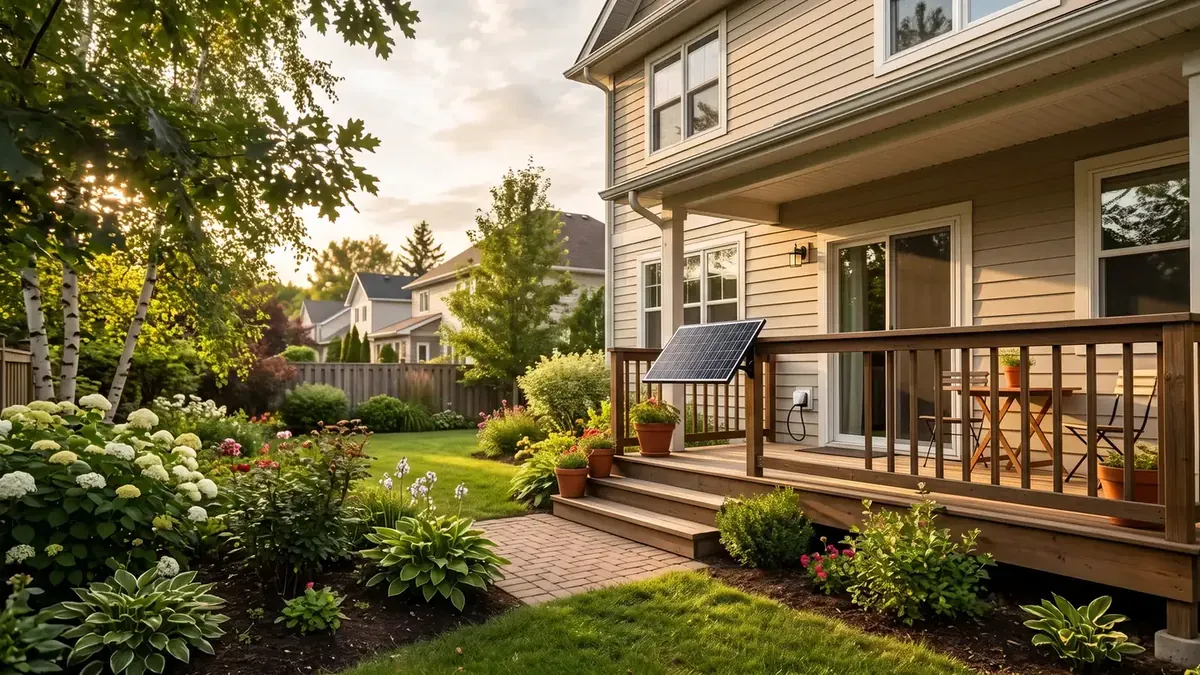
- No plug-in solar law in West Virginia yetBill HB 5648
- The utility rules apply.There's no cap on plug-in wattage.
- That's 15.6 cents.Average home price per kWh from EIA, Jan to Aug 2026.
- $156 each year.In Charleston, an 800 W kit, before any utility solar fee.
In West Virginia, get approval from your electric utility before you connect, and use an inverter with anti-islanding listed to UL 1741, or listed to UL 3700 instead.
West Virginia Plug-In Bills
- HB 5648 (2026): broad bill on electric consumer protection (Del. Eldridge) would have defined, in its new section 24-2F-1, portable solar devices of no more than 1,200 W, UL or NRTL certified. Such devices would be exempt from interconnection agreements, would not qualify for net metering, and would need no utility approval, fee, or extra equipment. House Energy and Public Works received the bill on 17 Feb 2026. On 2 Mar 2026 a discharge motion was tabled, and it stopped there in the 2026 regular session. Bill page
West Virginia's Rule Today
Connecting your system: PSC interconnection standards apply at two levels. Level 1 handles generators rated 25 kW or less, and the application fee tops out at $30. Inverter-based systems of up to 25 kW need no external disconnect switch at all. At Mon Power and Potomac Edison, include a one-line diagram and a site plan with your application.
Net metering: every retail customer can use it, and the aggregate cap sits at 3% of peak demand. Any extra power rolls over as a kWh credit, paid at the retail rate, and there's no annual true-up. Customers who signed up with Mon Power and Potomac Edison since 1 Jan 2025 are credited roughly 8.91 to 9.34 cents/kWh.
Kit Savings in West Virginia
PVWatts estimates that panels of 1 kW in Charleston generate 1,254 kWh each year. Homes in West Virginia pay 15.6 cents for every kWh they use in 2026 so far. Where you put an 800 W kit changes the results:
| Where the panels go | kWh a year | Saved a year |
|---|---|---|
| Tilted south on a stand | 1,003 | $156 |
| Upright on a railing | 632 | $98 |
| Facing east or west | 803 | $125 |
Charleston, Month by Month
- Jan56
- Feb65
- Mar84
- Apr92
- May100
- Jun104
- Jul102
- Aug103
- Sep90
- Oct83
- Nov70
- Dec56
What an 800 W kit makes in kWh, tilted south.
Kit Prices in West Virginia
| Kit | kWh a year | Saved a year | Pays back in | Price |
|---|---|---|---|---|
| US Solar Supplier 1180 W EZ1 Kit | 1,480 | $231 | 3.9 years | $899 |
| Bright Saver 360 W Balcony Kit | 451 | $70 | 5.9 years | $414 |
| EcoFlow STREAM 800 W Kit | 1,003 | $156 | 7.0 years | $1,099 |
Tilted south, with all output used at home. Compare all kits
West Virginia: Worth Knowing
- Coal fuels most of West Virginia's power, and it's the state's main energy source. In 2024, no state had a higher carbon dioxide rate per MWh than West Virginia's plants. That means every kWh a plug-in kit replaces cuts more emissions than in most states.
- Power isn't cheap anymore: the average residential price rose to 15.07 cents/kWh in 2024, up from 11.80 cents/kWh in 2020.
- Mon Power and Potomac Edison credit new solar customers since 2025 about 9 cents/kWh for exported power, not the full retail rate. So the power you use at home is worth more than what you send back.
On a Balcony, or Renting?
Decisions about the mount come from your landlord or HOA; decisions about the hookup come from your electric utility. Take a look at balcony solar and solar for apartments.
Key Utilities
- Monongahela Power (Mon Power)
- Appalachian Power
- Wheeling Power
- Potomac Edison
Next Steps for You in West Virginia
- Choose a kit size. In Charleston, the 400 W kit produces about 502 kWh a year, and the 1,200 W kit produces about 1,505 kWh. Run your own numbers
- Keep an eye on HB 5648 in the next session. Should the bill pass, you might not need that approval step anymore.
Sources
- Bill Status - Complete Bill History, House Bill 5648, 2026 Regular Session, West Virginia Legislature
- HB 5648 Text (introduced), West Virginia Legislature
- DSIRE West Virginia Interconnection Standards
- West Virginia Interconnection, FirstEnergy (Mon Power, Potomac Edison)
- DSIRE West Virginia Net Metering
- EIA State Electricity Profile tables, West Virginia 2024
- NREL PVWatts, Charleston plus EIA Table 5.6.B, 2026 prices
All states at a glance, or check a neighbor: Ohio, North Carolina, Kentucky.