
Plug-In Solar Savings Calculator
Answer three questions: where the panels go, which kit you have, and your state. You'll see what your set of panels saves a year and when it pays for itself.
State-by-State Plug-In Solar Savings
- A ready-to-plug-in kit that makes up to 800 watts (a watt is a small unit of power)
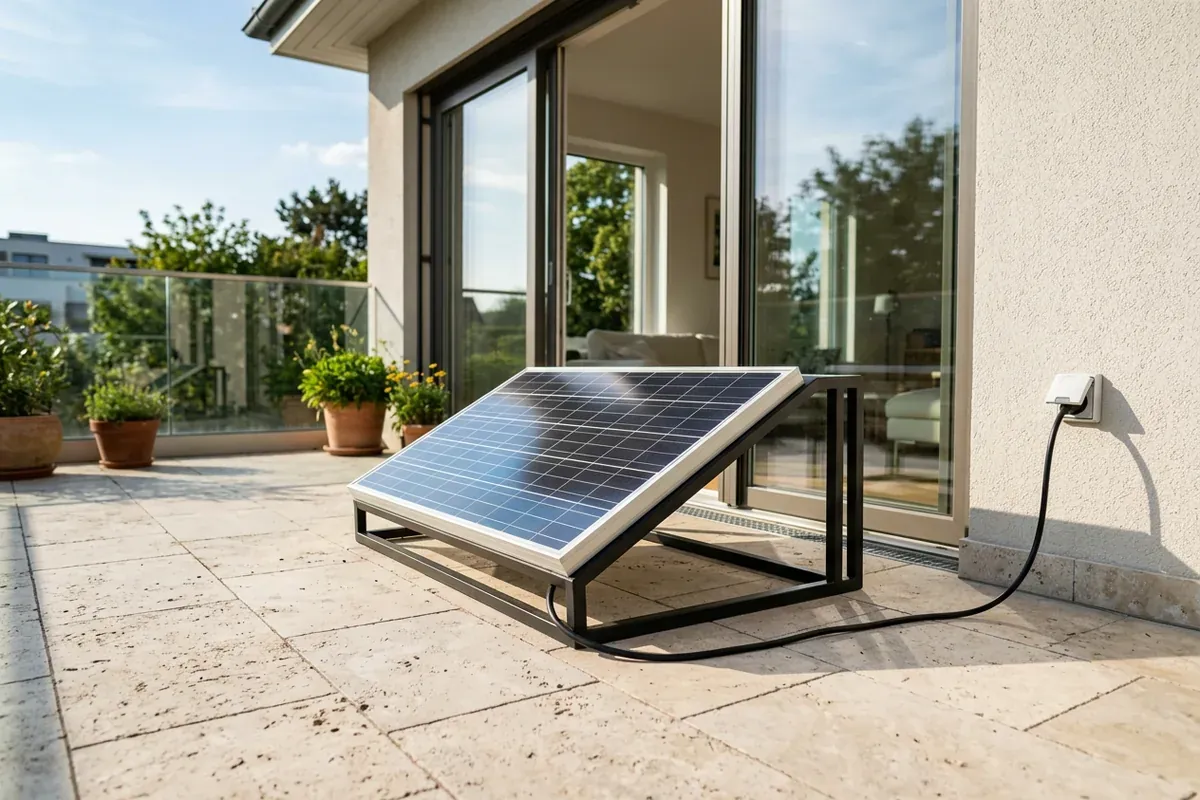
- Panels angled up 30 degrees, facing south, for the most sun
- We use the sunshine in each state's biggest city, so yours may differ.
- We use home power prices for 2026 so far.
- We assume your home uses all the power the panels make
All 50 states and Washington, DC, with the biggest savings at the top
| State | Saved a year | Pays for itself in |
|---|---|---|
| Hawaii | $587 | 1.9 years |
| California | $444 | 2.5 years |
| Maine | $328 | 3.4 years |
| Massachusetts | $324 | 3.4 years |
| Rhode Island | $310 | 3.5 years |
| New York | $307 | 3.6 years |
| Connecticut | $302 | 3.6 years |
| New Hampshire | $281 | 3.9 years |
| Washington, DC | $276 | 4.0 years |
| New Jersey | $257 | 4.3 years |
| Maryland | $242 | 4.5 years |
| Vermont | $241 | 4.6 years |
| Pennsylvania | $235 | 4.7 years |
| Michigan | $228 | 4.8 years |
| New Mexico | $223 | 4.9 years |
| Colorado | $220 | 5.0 years |
| Arizona | $220 | 5.0 years |
| Wisconsin | $207 | 5.3 years |
| Alaska | $207 | 5.3 years |
| Illinois | $205 | 5.4 years |
| Delaware | $200 | 5.5 years |
| Ohio | $200 | 5.5 years |
| Virginia | $196 | 5.6 years |
| Nevada | $192 | 5.7 years |
| Kansas | $190 | 5.8 years |
| South Carolina | $187 | 5.9 years |
| Indiana | $185 | 5.9 years |
| Alabama | $183 | 6.0 years |
| Texas | $182 | 6.0 years |
| Minnesota | $181 | 6.1 years |
| Florida | $180 | 6.1 years |
| Wyoming | $177 | 6.2 years |
| Georgia | $176 | 6.3 years |
| North Carolina | $175 | 6.3 years |
| Mississippi | $172 | 6.4 years |
| Oklahoma | $171 | 6.4 years |
| South Dakota | $169 | 6.5 years |
| Missouri | $167 | 6.6 years |
| Iowa | $163 | 6.7 years |
| Utah | $160 | 6.8 years |
| Arkansas | $157 | 7.0 years |
| Louisiana | $157 | 7.0 years |
| Montana | $157 | 7.0 years |
| West Virginia | $156 | 7.0 years |
| Kentucky | $156 | 7.0 years |
| Idaho | $155 | 7.1 years |
| Nebraska | $151 | 7.3 years |
| Tennessee | $149 | 7.4 years |
| Oregon | $142 | 7.7 years |
| North Dakota | $133 | 8.3 years |
| Washington | $128 | 8.6 years |
"Pays for itself in" means how many years until the money you save adds up to the price of the kit. We use $1,099 for the kit, the cheapest 800-watt kit in our list. You can also download every state's sunshine and power price as a spreadsheet (a CSV file that opens in Excel): plug-in-solar-savings-by-state.csv. We took sunshine from PVWatts and home power prices from the EIA's monthly electricity report.
How We Work It Out
Sunshine numbers come from PVWatts, a free tool from NREL (the National Renewable Energy Laboratory, a US government lab for clean energy). For each state's biggest city, we ran it with panels tilted 30 degrees and facing south. Home power prices for 2026 so far come from the US Energy Information Administration (EIA), the government's office for energy data. Your answer about where the panels go changes the result: panels that stand straight up, or face east or west, make less power.
All these numbers assume your home uses the solar power right when the panels make it. If nobody is using power during the day, the extra goes out to the power company. The power company may pay you little or nothing for that power. Some power companies charge a monthly fee if you have solar. If yours does, you will save a little less than shown.
Next, compare the kits or find out if your state allows plug-in solar.